Ads used to be here |
 |
 |
 |
 |
 |
 |
 |
 |
| Calendar |
|
Holidays |
|
FOR IMMEDIATE RELEASE Event:
Saturday, August 24, 2002 SAN
FRANCISCO CINEMATOGRAPHER
For his pioneering contributions as an Asian American in independent filmmaking and public television, Michael Chin has been named recipient of the 2002 STEVE TATSUKAWA MEMORIAL FUND AWARD. The Award will be presented on August 24 at CHILIVISIONS, the annual fundraiser for Visual Communications, Asian Pacific Media Arts Center in Los Angeles. The event will be held at the George & Sakaye Aratani/Japan America Theatre in Little Tokyo. Michael is the 23rd recipient of the Award, established to recognize those who carry on Tatsukawa's legacy of community service and commitment to the advancement of the Asian Pacific American media arts. Tatsukawa was one of the nation's highest ranking Asian American public television executives in the program department at KCET--Southern California PBS, executive director of VISUAL COMMUNICATIONS, national media advocate, filmmaker and community activist. His comic sensibility, incisive commentary and creative brilliance was much admired, and when he passed away in 1984 at age 35, his friends were compelled to commemorate Tatsukawa's achievements and irrepressible spirit. They formed an ad hoc committee and began to select recipients for an annual $1000 award, supported solely through individual donors. Eighteen years after his death, Tatsukawa still elicits the devotion and generosity of people across the country. Born in Salinas, California, the son of Henry and Dorothy Chin, Michael Chin worked throughout his youth at the Chin Brother's Market run by his father and uncles. He recalls that the market was more than just a store, a place where people from the Chinese American community would socialize after work, where everyone was on a first-name basis. Although Mike's interests when growing up were more in art, food, and the San Francisco Giants than in filmmaking, his uncle Parker Chin encouraged him to use an 8mm movie camera to shoot family events. His early interest in art led him to San Francisco State College in the late 60s where he majored in printmaking. It was there that he met James Dong, Connie Chang and other politically active artists who banded together to form the legendary Kearny Street Workshop-a grassroots collective that remains productive today as the oldest multidisciplinary Asian Pacific American arts organization in the country. While working at the De Young Museum in San Francisco shooting Super 8mm film loops that accompanied the exhibits, he met many of the pioneers of the Bay Area filmmaking community. Loni Ding, Asian American Studies professor at University of California, Berkeley, and producer at KQED, the Bay Area PBS station, was beginning work on Beansprouts, an Asian American childrens' series, and she offered Mike a production assistant job. Mike credits Ding with encouraging his career development: "It was at that point, being able to observe the experienced cinematographers shooting Beansprouts, that I really developed my interest in camera work. Loni gave us staff members the opportunity to grow." With Loni's help, Michael landed a grant to intern with a professional in a chosen field. He was assigned to veteran director/cinematographer Jon Else, who was then editing his Academy-Award-nominated documentary about the atomic bomb, Day After Trinity. It was the start of a mentorship that was to last for decades, Michael doing every task from filing film trims in the edit room to loading film. Else, now a professor in the Graduate Journalism Department at University of California, Berkeley, observes: "Mike was always rock-steady reliable; soft-spoken, but tough, he could walk from the bottom of the Grand Canyon to the top with a full load of gear." In 1980, after freelancing as a camera assistant on several Bay Area productions, he heard that Wayne Wang, then a social worker at a Chinatown agency, had received an American Film Institute grant to direct a film. "I just called him and asked, 'Well, do you have anybody to shoot for you?' And he said no. And I said, 'I'll do it for you if you want to take a chance.'" On this seemingly audacious move Mike observes, "No one offers the Director of Photography job to a camera assistant. You have to take the initiative by volunteering to do it for free." With Michael on camera and Curtis Choy on sound, Wang's minimal crew would shoot on weekends around Chinatown. Michael remembers Wayne as a "smart cookie" who knew conceptually the shots that he wanted and who would diagram scenes rather than rely on a written script. The camera was entirely subjective and handheld, and it was a formidable challenge to execute the shots with rudimentary equipment-and little experience. "If you look at the film," Michael admits, "there were certainly a lot of mistakes, but the charm of the film is its roughness." Chan Is Missing premiered at the 1982 New Directors Film Series in New York and critic Vincent Canby of the New York Times raved about the movie's spare, evocative style and its distinctive affirmation of Asian American life. The ultra-low budget film (under $25,000) was released nationally and earned over a million at the box office. Michael gleefully recounts the joy of seeing people lined up around a Manhattan block under the CHAN IS MISSING marquee: "It was amazing! In spite of all the mistakes it turned out okay!" However, the success of Chan did not automatically guarantee career stability or financial reward. Mike's father questioned the seriousness of his "hobby" and asked him to return home to run the family market. But despite the unpredictability of freelancing, he persevered, gradually compiling an impressively diverse body of work.
He reunited with Emmy-winning producer Loni Ding in 1984, this time as the cinematographer on Nisei Soldier and again in 1987 on The Color of Honor, two of the earliest documentaries on Japanese Americans in the United States military during World War II. Mike has also shot films for several other Asian American directors, including Arthur Dong, (Forbidden City, U.S.A., 1990), Deanne Borshay Liem (First Person Plural, 2000), Louise Lo, (The Floating World of Masami Teraoka, 2001) and Philip Kan Gotanda (The Kiss 1993, Drinking Tea, 1995, and Life Tastes Good, 1999). Michael looks back proudly on his involvement as an assistant and cinematographer on Eyes on the Prize, I & II. The fourteen total episodes for these two PBS series on the Civil Rights movement provided an opportunity for him to meet and film many of the most newsworthy figures of our time, including Rev. Jesse Jackson, Tom Hayden, Myrlie Evers, Kareen Abdul Jabbar and Muhammed Ali. In the last decade, Mike has filmed several projects of social, historical and cultural significance about African Americans, several of them produced and directed by Orlando Bagwell. The two met years ago while both were assistants loading film on a documentary on the Cotton Club in Harlem for a series called Were You There? Mike's long friendship with Orlando has resulted in numerous collaborations: Roots of Resistance (1990); Malcolm X: Make It Plain (1994); Frederick Douglas: When the Lion Wrote History (1995); and, Africans in America (1998). Always generous in helping aspiring cinematographers, filmmakers and assistants, Mike has also donated his skills in service of community media projects. He has shot sequences for the Media Arts Center of the Japanese American National Museum, and, last summer, he flew to Arizona to operate one of the multiple cameras recording local Senshin Buddhist Temple's Horaku concert in Canyon de Chelly. The Chin Brothers Market was sold in 1990 ending an era in the Chinese American community of Salinas-and ruling out any possibility of Mike's eventual return to the grocery business. By that time, however, his stature as one of the country's most highly respected cinematographers was secure. At the 1991 Academy Awards, Producers Allie Light and Irving Saraf took time in their acceptance speech to acknowledge Michael's critical contributions to the Oscar-winning documentary on opera singers, In the Shadow of the Stars. This past July Mike was nominated for a Prime-Time Emmy Award, "Outstanding Cinematography for Non-Fiction Programming," for his camera work on the PBS documentary, Ansel Adams. His co-nominees were veterans, Buddy Squires and Jon Else. The nomination confirms what many who have worked with him believe: that Michael belongs to a select group of peers in the world of documentary filmmaking. In attaining status equal to Else, his longtime mentor, he has himself grown to become a consummate filmmaker. Upon notification of the Steve Tatsukawa Award, Mike commented with characteristic modesty: "At first, I didn't believe it! But after I found out they weren't pulling my leg, I was really humbled and honored to join such illustrious company. To quote a line from the movie Dim Sum, 'My reality is bigger than my dreams!'" Michael Chin will be present with many of his friends and family on Saturday, August 24, to accept the 2002 Tatsukawa Memorial Award at the 7:30 p.m. screening program of CHILIVISIONS XV, Japan America Theatre, 244 S. San Pedro Street, Los Angeles, California. For information, please call (213) 680-4462, ext. 21. The Tatsukawa Memorial Awards Committee encourages donations to sustain the fund to its 20th Anniversary in 2004. Donations may be sent to the Steve
Tatsukawa Memorial Fund -- John Esaki (Esaki is Director of the Frank H. Watase Media Arts Center of the JAPANESE AMERICAN NATIONAL MUSEUM.) |
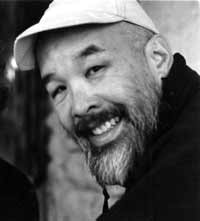 Michael
Chin, the modest son of a corner grocer from Salinas, California,
has lighted and composed powerful images for many of today's most
influential documentaries on race, class and culture. Among Mike's
numerous credits as a cinematographer are works as varied as: The
Color of Honor, the story of the 100th/442/MIS; Eyes
on the Prize, a landmark public television series on the
Civil Rights movement; and, The Great Depression,
which chronicled a decisive era in American history.
Michael
Chin, the modest son of a corner grocer from Salinas, California,
has lighted and composed powerful images for many of today's most
influential documentaries on race, class and culture. Among Mike's
numerous credits as a cinematographer are works as varied as: The
Color of Honor, the story of the 100th/442/MIS; Eyes
on the Prize, a landmark public television series on the
Civil Rights movement; and, The Great Depression,
which chronicled a decisive era in American history. 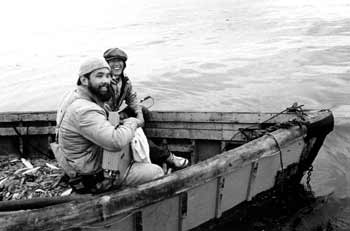 He
collaborated with the inimitable Spencer Nakasako -- one
of his favorite directors--who tapped Michael in 1982 to shoot Monterey's
Boat People, a documentary on the Vietnamese and Italian fisherman
of Spencer's home town. Mike also cherishes the memory of shooting
Q It Up, a short drug education drama for the United Way in 1985
because of the family atmosphere created by Nakasako on the set.
He
collaborated with the inimitable Spencer Nakasako -- one
of his favorite directors--who tapped Michael in 1982 to shoot Monterey's
Boat People, a documentary on the Vietnamese and Italian fisherman
of Spencer's home town. Mike also cherishes the memory of shooting
Q It Up, a short drug education drama for the United Way in 1985
because of the family atmosphere created by Nakasako on the set.
 |
|||
|
 |
|
|
| | About Us | Disclaimers and Legal Information | Advertise With Us | We welcome your comments. Send e-mail to us at info@asianconnections.com Copyright ©1999-2002 AsianConnections.com |